Cash Flow Problems: 5 Financing Solutions for Canadian Businesses

Explore five effective financing solutions to overcome cash flow problems and keep your business thriving in challenging economic times with Jocova Financial.
, July 16, 2025
Cash Flow Problems: 5 Financing Solutions
Cash flow can make or break your business. In Canada, 68% of small businesses faced cash flow issues in 2022, and 87% reported late payments. Even profitable businesses struggle when liquidity is tight, with 82% of small business failures tied to poor cash flow management.
To tackle these challenges, here are five financing solutions that can help keep your business running smoothly:
- Equipment Financing: Spread out payments for tools and machinery instead of paying upfront.
- Equipment Leasing: Access equipment without ownership, with flexible payment terms.
- Business Loans & Working Capital: Quick cash for daily operations or growth.
- Dealer Financing: Combine equipment purchase and financing in one simple process through Equipment Financing or Equipment Leasing Options.
- Government-Backed Loans (CSBFP): Easier access to funds with lower risk for lenders.
Each option is tailored to specific needs, whether it’s preserving cash flow, upgrading equipment, or covering operational costs. The right choice depends on your business goals and cash flow situation.
How to Fix Your Business’s Cash Flow Problems in 5 Steps
Equipment Financing: Buy Equipment Without Large Upfront Costs
Equipment financing provides Canadian small businesses with a practical way to get the tools they need without draining their cash reserves. Instead of paying the full cost upfront, businesses can spread payments over time, keeping funds available for day-to-day operations and unexpected needs. Here’s a closer look at its benefits, eligibility requirements, and how it compares to outright purchases.
Benefits of Equipment Financing
Some major advantages include:
- Preserving Cash Flow: Avoid large upfront payments and keep funds available for other priorities.
- Custom Payment Plans: Tailored schedules that align with your revenue cycle.
- Simplified Budgeting: Fixed monthly payments make planning easier.
- Tax Advantages: Monthly payments may qualify for deductions, reducing overall costs. Review with your accoutant
- Upgrading Options: Easier to replace equipment before it becomes outdated.
“Financing equipment is a cost-effective way for small businesses to acquire assets based on their cash flow.” – Jocova Financial, Elliott
Eligibility and Terms
Most Canadian businesses can qualify for equipment financing or equipment leasing, provided they meet some basic criteria. Generally, you’ll need at least 12 months of operating history, steady revenue, good credit, and enough working capital to manage monthly payments.
Terms
- Duration: Typically, loans range from 12 to 84 months, offering manageable payments while allowing immediate use of the equipment.
- Interest Rates: Rates vary between 6% and 19% APR, though well-qualified borrowers may secure rates low rates such as 0% through manufactured sponsored programs. Rates are also impacted by term and amount.
- Collateral: The financed equipment often serves as collateral, which can help lower your interest rate.
Approval rates are high, with Jocova Financial’s credit team reporting that nearly 90% of applications get approved, and funds can be available within the same day in a lot of cases.
Comparison: Financing vs. Outright Purchase
To decide between financing and buying outright, it’s important to weigh the impact on your cash flow and long-term goals. Here’s a quick comparison:
| Feature | Equipment Financing | Outright Purchase |
|---|---|---|
| Cash Flow Impact | Preserves cash for other operational needs | Requires significant upfront cash |
| Ownership | May or may not include immediate ownership | Immediate full ownership |
| Tax Benefits | Possible deductions on monthly payments | Depreciation claimed over time |
| Flexibility | Offers flexible terms and upgrade options | Limited flexibility; asset is fixed |
| Monthly Expenses | Fixed monthly payments | No ongoing payments after purchase |
| Credit Requirements | Must qualify with credit check | No credit requirements |
For businesses managing tight cash flow or planning for growth, equipment financing can be a smart way to secure essential tools without compromising financial stability.
Leasing Options: Flexible Equipment Access Without Ownership (immediately)
For Canadian small businesses, leasing offers a practical way to access essential equipment without the commitment of ownership. Unlike an outright purchase, leasing allows you to use equipment for a defined term while the lessor retains ownership. This flexibility is especially useful in times of inflation and economic uncertainty – fitting for an industry valued at $38.5 billion. Following term maturity, many leases auto-terminate and pass ownership of the equipment to the lessor for a nominal fee that is auto-debited (i.e. $100).
Leasing spreads costs into manageable monthly payments, preserving your cash reserves for other priorities. Whether it’s construction machinery, medical devices, or software, leasing gives you access to the tools you need without draining your working capital. Let’s explore the different lease structures available and how they can fit your business needs.
Most Popular Types of Leases
Leasing options can be tailored to align with your business goals and financial strategy. Here’s a closer look at the main types:
- Finance Leases: Also known as capital leases, these are closer to ownership. The equipment appears on your balance sheet as both an asset and a liability, making it a good choice for items with a long lifespan. You get the benefits of ownership without the upfront cost.
- Sale-Leaseback: This option lets you sell equipment you already own to a leasing company and then lease it back. It’s a way to free up capital while continuing to use the equipment.
- TRAC Lease: This type of contract allows for an enhanced residual at the end of term. It helps reduce the monthly payment for cash flow, and provides additional flexibility come end of term
In British Columbia, for instance, construction companies are using lease-to-own models for heavy machinery like loaders and excavators. Meanwhile, medical clinics are leasing advanced imaging equipment and laser machines to expand into suburban areas like Langley and Delta without tying up capital. In Ontario, there are many companies financing construction, landscape, manufacturing, and transportation related equipment.
Advantages of Leasing
Equipment Leasing comes with several benefits that can help address the financial challenges small businesses often face:
- Cash Flow Preservation: Keep your working capital available for inventory, payroll, or unexpected costs.
- Tax Perks: Lease payments are could be fully deductible as business expenses. Review with your accountant
- Credit-Friendly: Leasing may not impact your credit as much as traditional loans depending on your provider.
- Upgrade Flexibility: At the end of the lease, you can return equipment and lease newer models or take over ownership of the equipment.
- Predictable Costs: Fixed monthly payments simplify budgeting; no changes due to interest rate, especially for businesses with seasonal revenue.
Business Loans and Working Capital: Quick Access to Operating Funds
In addition to equipment financing and leasing, business loans and working capital solutions provide businesses with immediate cash to handle operations or support growth. Unlike equipment financing, which is tied to specific assets, these options offer a lump sum that can be allocated flexibly based on the business’s needs.
Working capital loans are particularly useful for covering daily operations during cash flow shortages. For instance, some businesses will by building supplies for a job, some may cover payroll while waiting for a large cheque to clear, and others may make a tax payment owed.
Benefits of Business Loans
Business loans come with several advantages for managing cash flow issues. The approval process is often quicker than traditional financing methods, and borrowers don’t need to specify how the funds will be used. This quick access to funds is essential for addressing unexpected challenges, such as covering payroll, rent, or debt payments. The flexibility also allows business owners to invest in other areas like inventory, marketing, or hiring.
Government programs like the Canada Small Business Financing Program (CSBFP) further support small businesses by sharing risk with lenders. Over the past decade, more than 53,000 CSBFP loans, totalling over $11 billion, have been issued to small businesses. These loans include both term loans and lines of credit, which can be used for various purposes, including working capital.
Comparison of Financing Options
To better understand the available financing options, here’s a breakdown of common methods. Each serves as a valuable tool for addressing the persistent cash flow challenges faced by Canadian small and medium-sized enterprises (SMEs):
| Financing Option | Ideal For | Approval Speed | Interest Rate | Repayment Structure | Key Advantage |
|---|---|---|---|---|---|
| Term Loans | Long-term needs, major purchases | Moderate | Fixed or variable rates | Fixed monthly payments over a term | Predictable payments, larger amounts |
| Lines of Credit | Short-term expenses, seasonal fluctuations | Fast | Variable, only on drawn amount | Flexible draw and repayment | Pay only for what you use |
| Merchant Cash Advances | Immediate cash needs for businesses with strong card sales | Very fast | Higher cost | Daily percentage of card sales | Quick access, no fixed payments |
Term loans are ideal for significant, long-term working capital needs. Under the CSBFP, businesses can borrow up to $1,000,000, with interest rates set at the lender’s prime rate plus 3%. These loans come with predictable monthly payments, making them easier to budget for.
Lines of credit offer more flexibility for managing fluctuating cash flow. You can draw funds as needed and only pay interest on what you use. Through the CSBFP, businesses can access lines of credit up to $150,000 at the lender’s prime rate plus 5%. This option is particularly helpful for businesses with seasonal revenue or unexpected opportunities.
Merchant cash advances, while offering the fastest access to funds, come with higher costs and shorter repayment terms. They are best suited for businesses that need immediate cash flow. Jocova can help offer these along with traditional working capital loans.
When deciding on the best financing option, evaluate your cash flow needs based on historical trends and current demands. Consider factors like the turnover of accounts receivable and inventory to measure working capital efficiency. Accurate cash flow forecasts can help you determine the right loan size while ensuring repayment doesn’t strain your operations.
Dealer and Manufacturer Financing Programs: Direct Equipment Financing
Dealer and manufacturer financing programs offer a practical alternative for Canadian businesses navigating cash flow challenges. These programs connect businesses directly with equipment suppliers and their financing partners, eliminating the need for third-party lenders. Unlike traditional bank loans, which often involve separate applications and approvals, dealer financing combines the equipment purchase and financing into a single transaction. This approach reduces paperwork and speeds up the approval process, providing quicker access to equipment along with competitive rates and flexible terms. Jocova Financial runs many equipment dealer and manufacturing financing programs in this fashion designed to provide dealers and customers a seamless and convenient way to acquire equipment.
Streamlined Procurement
One of the biggest advantages of dealer and manufacturer financing with Jocova Financial for instance is how it simplifies the procurement process. By cutting out third-party lenders not associated with the dealer, businesses can handle equipment selection, financing applications, and approvals in one go – often completing the entire process in a single day. This streamlined approach is especially useful in urgent situations, such as when equipment breaks down or when market opportunities demand quick action.
Dealer financing integrates the purchase and funding process, making it easier for businesses to secure the tools they need. A good vendor financing partner can even create custom programs to help businesses move inventory faster and close deals more efficiently. Additionally, dealers and manufacturers often work with a network of financing partners, offering a range of options tailored to various credit profiles and business needs. This flexibility increases the chances of approval, even for businesses that may struggle with traditional lenders.
Benefits for Canadian Businesses
Beyond simplifying the process, dealer financing delivers key financial benefits for Canadian small businesses. One standout advantage is the competitive rates often available through these programs. Manufacturers sometimes subsidize financing to boost sales, making their offers more attractive than traditional loans or credit lines.
“The equipment leasing promotions on equipment are generally very compelling when you’re dealing with a manufacturer’s subsidy program which can have rates starting at 0%” – Elliott, Jocova Financial
These competitive rates can lead to lower overall financing costs. Manufacturers may also offer promotional rates and special terms that are unavailable through conventional lending channels. Another benefit is the flexibility of payment plans, which can be tailored to match a business’s cash flow. For example, seasonal businesses or startups with irregular revenue streams can opt for payment structures that align with their financial cycles.
Dealer financing also offers quicker access to equipment. While traditional loans may take weeks for approval, dealer equipment financing and equipment leasing often provides same-day decisions and funding. These programs also cater to businesses that might not qualify for conventional loans, and they make it easier to upgrade equipment at the end of a lease term.
It’s important, however, to weigh the long-term costs and flexibility of any financing program against your business’s needs. Look for programs that accommodate a variety of credit profiles to maximize your options.
Government-Backed Financing Programs: Canada Small Business Support
Small businesses in Canada often face challenges when trying to secure traditional financing. To help address this, the Canada Small Business Financing Program (CSBFP) provides government-backed loans, making it easier for businesses to access the funds they need. By sharing the financial risk with lenders, the program opens doors for businesses that might otherwise struggle to qualify for loans.
The CSBFP is designed to support essential business needs like equipment upgrades, working capital, and other operational costs. It complements other financing options by reducing lender risk and easing credit requirements, offering much-needed relief to small businesses.
Overview of the CSBFP
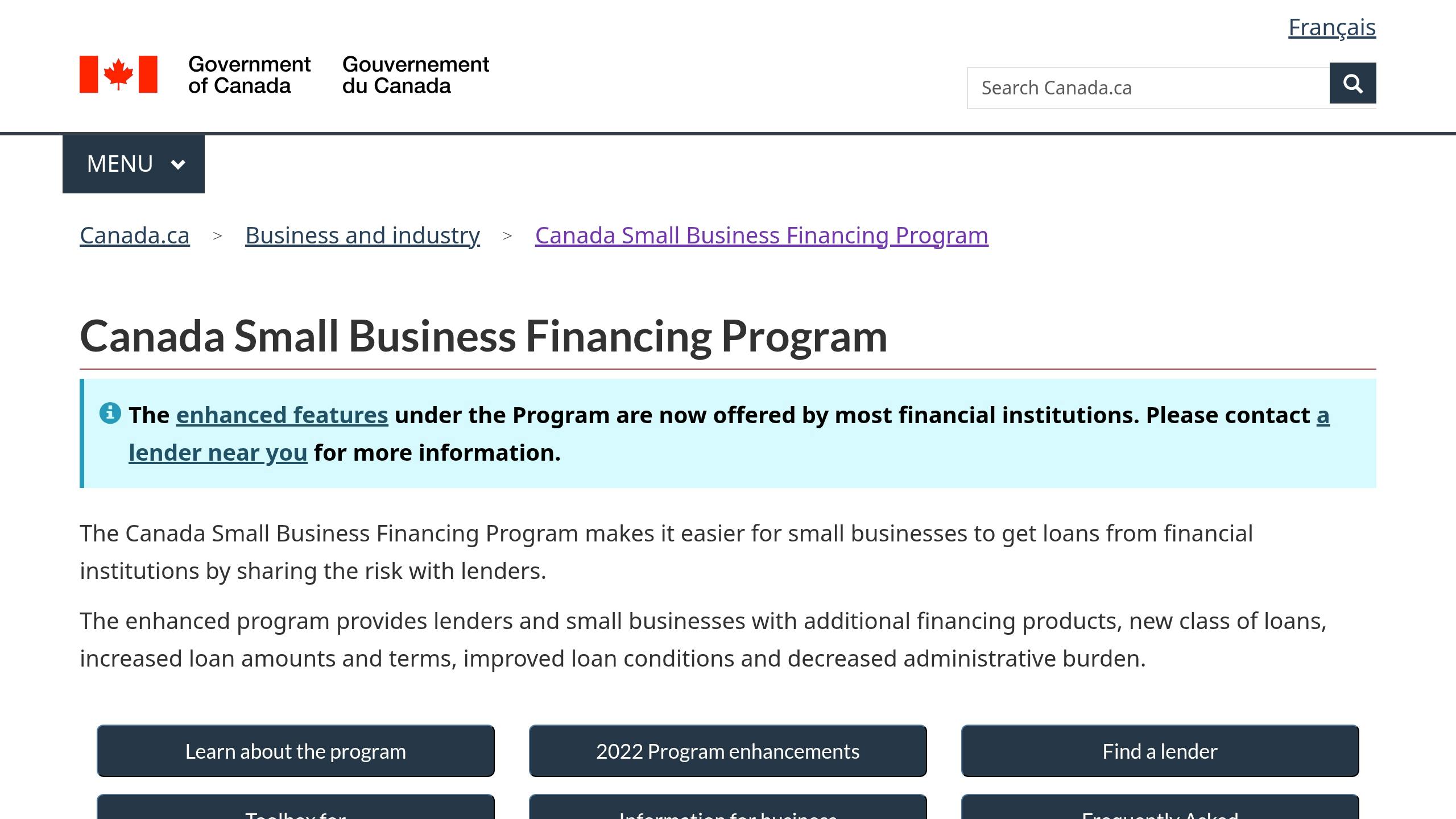
The CSBFP aims to help small businesses in Canada start, expand, or modernize their operations. While private lenders manage the loan process – including approvals and administration – the program provides the government backing that makes these loans more accessible.
To qualify, businesses must:
- Operate within Canada.
- Serve Canadian customers.
- Generate annual revenues of $10 million or less.
- Be for-profit enterprises.
The program supports most industries and offers two main financing options:
- Term Loans: Up to $1 million for purposes such as real property purchases, equipment, leasehold improvements, intangible assets, and working capital.
- Lines of Credit: Up to $150,000 to cover day-to-day operating expenses.
A 2% loan registration fee applies, which can be financed through the loan itself. Interest rates are capped at prime + 3% for variable loans or 3% above the lender’s residential mortgage rate for fixed-rate loans.
Since its launch in 1999, the CSBFP has been a significant source of financing for Canadian small businesses, facilitating over 200,000 loans worth nearly $27 billion. In 2023–24 alone, the program issued 6,238 loans, totalling close to $1.8 billion. Start-ups and businesses less than a year old received the bulk of these funds, accounting for $1.3 billion (73.5%).
The program’s funding in 2023–24 focused heavily on:
- Leasehold Improvements: $1.1 billion (61.4%).
- Equipment Loans: $363.6 million (20.5%).
- Working Capital and Intangible Assets: $54.2 million (3.1%).
The accommodation and food services sector was the largest beneficiary, receiving $859.0 million (48.5% of total loan value), followed by retail trade at $253.5 million (14.3%).
Comparison with Private Financing
The CSBFP stands out when compared to private financing options, as shown below:
| Feature | CSBFP Government-Backed | Private Financing |
|---|---|---|
| Government Guarantee | Up to 85% guarantee | No government backing |
| Maximum Loan Amount | $1 million term loan, $150,000 line of credit | Varies by lender and creditworthiness |
| Interest Rate Cap | Prime + 3% (variable) or mortgage rate + 3% (fixed) | Market rates, often higher for riskier businesses |
| Eligibility | Revenues under $10 million | Stricter credit and revenue requirements |
| Registration Fee | 2% of loan amount | Varies by lender |
| Risk Assessment | Shared risk encourages lending | Full lender risk |
Applications for the CSBFP are handled by participating banks and credit unions. The government guarantee often makes it easier for businesses with limited credit histories or collateral to secure funding. On the other hand, private financing typically demands stronger financial records, a solid credit history, and significant collateral. For small businesses needing quick access to capital, the CSBFP offers a practical and more accessible alternative by bridging the gap between traditional lending requirements and the realities many small businesses face.
Conclusion: Choosing the Right Financing Solution
Cash flow issues are a common hurdle for many small businesses across Canada, but the right financing solution can transform these challenges into opportunities for growth. Each financing option serves a specific purpose: equipment financing helps build equity, leasing conserves cash with flexible payments, business loans and working capital provide versatile funding, dealer financing streamlines procurement, and government programs make financing more accessible.
However, rapid growth without proper planning can be risky. Tim Berry from Entrepreneur.com highlights this danger:
“One of the toughest years my company had was when we doubled sales and almost went broke. We were building things two months in advance and getting the money from sales six months late. Add growth to that and it can be like a Trojan horse, hiding a problem inside a solution. Yes, of course you want to grow; we all want to grow our businesses. But be careful because growth costs cash. It’s a matter of working capital. The faster you grow, the more financing you need.” – Tim Berry, Entrepreneur.com
This underscores a critical point: 82% of small business failures stem from poor cash flow management or a lack of understanding. Before committing to any financing option, it’s essential to evaluate your loan purpose, repayment terms, collateral requirements, and the approval timeline. And don’t forget – the best time to secure financing is before you’re in urgent need, as it allows for better negotiation and more choices.
For Canadian small businesses, aligning your financing decision with your cash flow cycle is key. Considering that 61% of Canadian entrepreneurs feel they don’t know enough about available financing options, partnering with knowledgeable providers can make all the difference. Jocova Financial offers tailored services, including equipment financing, leasing, business loans, and working capital solutions, designed to meet the unique needs of Canadian businesses.
Your cash flow challenges don’t have to limit your potential. With the right financing partner and a well-suited solution, what seems like a setback today could become the foundation for sustainable growth tomorrow.
Other Posts